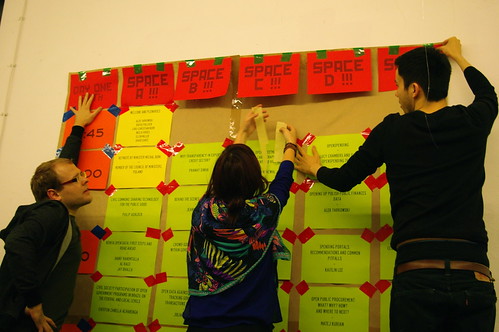
Jordan Hatcher, of opencontentlawyer.com and chair of the Advisory Council for the Open Knowledge Definition took the Public Domain Dedication & License out of beta on Saturday at OKCon.

The PDDL (which we blogged about in December) was initially sponsored by Talis and is specifically aimed at providing a suitable license for open data — taking account of rights in databases, such as those created by the EU Database Directive. As Jordan’s announcement states - the license is now ready for use. This is great news for producers and promoters of open data.

Our second annual Open Knowledge Conference (OKCon) is taking place tomorrow. Like last year, the event will bring together individuals and groups from across the open knowledge spectrum for a day of seminars and workshops. Though we’re nearing capcity, there are still a few places left for last minute registrants!

Details

Speakers

Session 1 (1045-1200): Transport and Environment

  • Gavin Starks (AMEE and dgen)
  • Tom Steinberg (MySociety)
  • Dr Muki Haklay (Department of Civil, Environmental and Geomatic Engineering, University College London)

Session 2 (1200-1315): Visualization and Analysis

  • Liz Turner (Freelance Designer and Visualizer Extraordinaire)
  • Gael Varoquaux (Mayavi2 - the next Generation Visualization Toolkit)
  • Martin Albrecht (SAGE the Open Source Mathematics Engine)

Session 3 (1415-1530): Education and Academia

  • Erik Duval (ARIADNE)
  • Lisa Petrides (OER Commons)
  • Dr Martin Brett (Cambridge University History Department and the Ivo Project)

Open Space

  • 1540-1640 (Room 1): Open Media
  • 1540-1640 (Room 2): Remixing, Peer Production and Open Knowledge
  • 1645-1745 (Room 1): Law, Licensing and Policy
  • 1645-1745 (Room 2): Versioning, Packaging, and Structuring Open Material
  • 1750-1830 (Room 1): Kept free for spontaneous contributions and breakout sessions

A more detailed schedule can be found at the Open Space wiki page

Theme

‘Open Knowledge’ is material that others are free to access, reuse or re-distribute and may be anything from sonnets to statistics, genes to geodata. In recent years we’ve seen the growth of successful open knowledge projects - from peer reviewed journals to community edited encyclopaedias - but what impact can open licensing have in education, research and commerce? Is sharing the key to scaling? What kinds of business models are available to open knowledge distributors and how is open knowledge applied in different institutional and professional contexts?

Furthermore, there now exist large and growing amounts of open material but what kinds of tools are available to analyse and represent it? How can we sort, search, store it to maximise its visibility and reusability?

We’ve also witnessed in the last few years the rise of web-based services — from social networking sites to online spreadsheet packages. While we have definitions for open software and open knowledge, what is an open service and what kinds of new services can be built using open knowledge?

Organizers

OKCon is organized by the Open Knowledge Foundation in partnership with the LSE Information Systems and Innovation Group.

We are pleased to announce the launch of an Advisory Council for opendefinition.org. The Council will be formally responsible for maintaining and developing the Definitions and associated material found on the Open Definition site - including the Open Knowledge Definition and the Open Service Definition. As many of you will know, these definitions aim to provide clear and succinct sets of conditions for ‘openness’ in knowledge and services.

Jordan Hatcher of opencontentlawyer.com has kindly agreed to be Chair of the Council, which includes:

  • Paul Jacobson, iCommons
  • Paul Miller, Talis
  • Peter Murray-Rust, Cambridge University
  • Rufus Pollock, Open Knowledge Foundation & Cambridge University
  • Rob Styles, Talis
  • Peter Suber, Scholarly Publishing and Academic Resources Coalition (SPARC) & Earlham College
  • Luis Villa, Columbia Law School, GNOME Foundation & Open Source Initiative
  • Jo Walsh, Open Knowledge Foundation & Open Source Geo-Spatial Foundation
  • John Wilbanks, Science Commons

More detailed biographies are available on the Advisory Council page.

It is our intention that the overall development of the material on the site will continue in the same community based and collaborative manner. The Council’s role will be to provide oversight, guidance and input into this process, not to replace it.

This is fantastic news for the definitions projects!

Tomorrow I’ll be speaking with Nate Olson at the latest Oxford Geek Night on the subject of Open Knowledge and Componentization. Here’s the blurb:

Componentization on a large scale (such as in the Debian ‘apt’ packaging system) has allowed large software projects to be amazingly productive through their use of a decentralised, collaborative, incremental development process. Componentization works so well because it allows us to ‘divide and conquer’ the organizational and conceptual problems of highly complex systems. Given this, what are the possibilities (and problems) of this approach for knowledge generally? How do we best design “knowledge APIs”, discover and distribute existing resources, and recombine decentralised datasets? In this talk we’ll discuss the answers to (some of) these questions focusing particularly on the role the Comprehensive Knowledge Archive Network can play.

So, if you’re in the Oxford vicinity and interested in Open Knowledge and related matters (there’s a good line-up of other speakers including Denise Wilton of moo.com) why not drop in to the Jericho Tavern around 7.30pm tomorrow evening.

CKAN 0.5 Released

February 1st, 2008

The Comprehensive Knowledge Archive Network (CKAN) version 0.5 has just been released.

Changes include:

  • feature to list and search tags
  • feature to make data available in machine-usable form via sql dump
  • feature to purge a revision and associated changes
  • support for reserved html characters in urls
  • upgrade to Pylons 0.9.6
  • new spam management utilities including (partial) blacklist support

The CKAN code is available from:

The data is available from:

We’ve currently got 135 packages. If you come across a large dataset or substantial collection, please consider registering it on CKAN!

Last night Science Commons announced the release of the Protocol for Implementing Open Access Data:

The Protocol is a method for ensuring that scientific databases can be legally integrated with one another. The Protocol is built on the public domain status of data in many countries (including the United States) and provides legal certainty to both data deposit and data use. The protocol is not a license or legal tool in itself, but instead a methodology for a) creating such legal tools and b) marking data already in the public domain for machine-assisted discovery.

As well as working closely with the Open Knowledge Foundation, Talis and Jordan Hatcher, Science Commons have spent the last year consulting widely with international geospatial and biodiversity scientific communities. They’ve also made sure that the protocol is conformant with the Open Knowledge Definition:

We are also pleased to announce that the Open Knowledge Foundation has certified the Protocol as conforming to the Open Knowledge Definition. We think it’s important to avoid legal fragmentation at the early stages, and that one way to avoid that fragmentation is to work with the existing thought leaders like the OKF.

Also, Jordan Hatcher has just released a draft of the Public Domain Dedication & Licence (PDDL) and an accompanying document on open data community norms. This is also conformant with the Open Knowledge Definition:

The current draft PDDL is compliant with the newly released Science Commons draft protocol for the “Open Access Data Mark” and with the Open Knowledge Foundation’s Open Definition.

Furthermore Creative Commons have recently made public a new protocol called CCZero which will be released in January. CCZero will allow people:

(a) ASSERT that a workhas no legal restrictions attached to it, OR
(b) WAIVE any rights associated with a work so it has not legal restrictions attached to it,
and
(c) “SIGN” the assertion or waiver.

All of this is fantastic news for open data!

Following on from the success of our inaugural conference last year, we’re pleased to announce that the second Open Knowledge conference (OKCon) will take place on Saturday 15th March 2008.

The event will bring together individuals and groups from across the open knowledge spectrum for a day of seminars and workshops around the theme of ‘Applications, Tools and Services’. Three main sessions will focus on ‘Transport and Environment’, ‘Visualization and Analysis’ and ‘Education and Academia’. In addition there will be an ‘Open Space’ suitable for presentations and demos of general open knowledge related work.

The event is open to all but we encourage you to register because space is limited. A small entrance fee is planned to help pay for costs but concessions are available.

More Information

‘Open Knowledge’ is material that others are free to access, reuse or re-distribute and may be anything from sonnets to statistics, genes to geodata. In recent years we’ve seen the growth of successful open knowledge projects - from peer reviewed journals to community edited encyclopaedias - but what impact can open licensing have in education, research and commerce? Is sharing the key to scaling? What kinds of business models are available to open knowledge distributors and how is open knowledge applied in different institutional and professional contexts?

There now exists a vast amount of open content and data but what kinds of tools are available to analyse and represent this wealth of material? How can we sort, search, store it to maximise its visibility and reusability?

We’ve also witnessed the rise of web-based services — from social networking sites to online spreadsheet packages. While we have definitions for open software and open knowledge, what is an open service and what kinds of new services can be built using open knowledge?

Want to give a presentation or demo? Want to help out?

If you have a presentation, demo or workshop you’d like to give, or would like to help out with OKCon 2008 please either post on the wiki (link above) or let us know by email on info [at] okfn [dot] org.

Recently the Agile Knowledge and Semantic Web research group (AKSW) at Universität Leipzig launched Cofundos.org. Confundos aims to help people share, refine, fund and realise new ideas for open software and knowledge projects. It was founded and developed by Sören Auer, who leads the AKSW research group (and is on the OKF’s advisory board).

The Confundos model for project development is very simple. The How does Confundos work? page conveys it in a neat schematic picture, the contents of which are roughly as follows:

  1. Someone proposes an idea for an open software/knowledge project
  2. Others discuss and refine the idea, suggest their own requirements, and bid money
  3. Specialists offer to realize the project and propose a price/timeline
  4. Bidders vote (weighted according to their bid) on which offer to accept
  5. The selected specialist realises the project
  6. Bidders vote whether project was successfully realised
  7. Bidders donate the bid amounts to the specialist

So far there 34 projects and 79 bids (amounting to over €3000). It looks like a funding and development model with a lot of potential. Relatively small bids could add up to be a substantial funding source for community developed projects. It also looks like a model that will work particularly well for open knowledge/software - as any interested party can come along and further customise the relevant code, content and/or data to their own specific requirements, if, for example, the results were not precisely as they had hoped or envisaged.

We’ll certainly furnish the site with some open knowledge projects in due course!

Open Database License

September 25th, 2007

Jordan Hatcher (Open Content Lawyer) and Dr. Charlotte Waelde (University of Edinburgh) have just published the first draft of the Open Data Commons, or the Open Database License. The new license was inspired by the Talis Community License (a draft open license for data from 2006) and its development has been sponsored by Talis.

The Database license limits itself to rights over databases - and hence does not cover rights in database content. A separate draft license, called the Factual Information License is intended to ensure that information that may not fall under the definition of a work in some juristictions is explicitly stated to be open. It stipulates:

2.4 Facts are free. The Licensor takes the position that factual information is not covered by copyright and neighbouring rights. This Licence grants you permission to Use the Work in jurisdictions that may protect the factual information in the Work by copyright, and to cover any other copyrighted information contained in the Work.

The new licenses certainly look to be the most well developed of the options discussed in our Guide to Open Data Licensing.

For further background information, see the Open Data home page at Open Content Lawyer and Paul Miller’s blog post on Nodalities.

KForge v0.14 Released

September 21st, 2007

Another release of KForge is out (mainly bugfixes and minor feature enhancements). Changes include:

  • Ensuring admin pages at /admin/ and not just /admin/model/.
  • Setting zip_safe to False in setup.py to avoid problems with apache/modpython.
  • Bringing the guide completely up to date.
  • Ensuring access control works with Apache 2.0 and not just 2.2.
  • Alphabetical sorting of projects and persons.
  • Removing redundant variables from configuration file.
  • Updating docstrings for plugins to include full installation instructions.

Full details in the release announce on the KForge project website.